
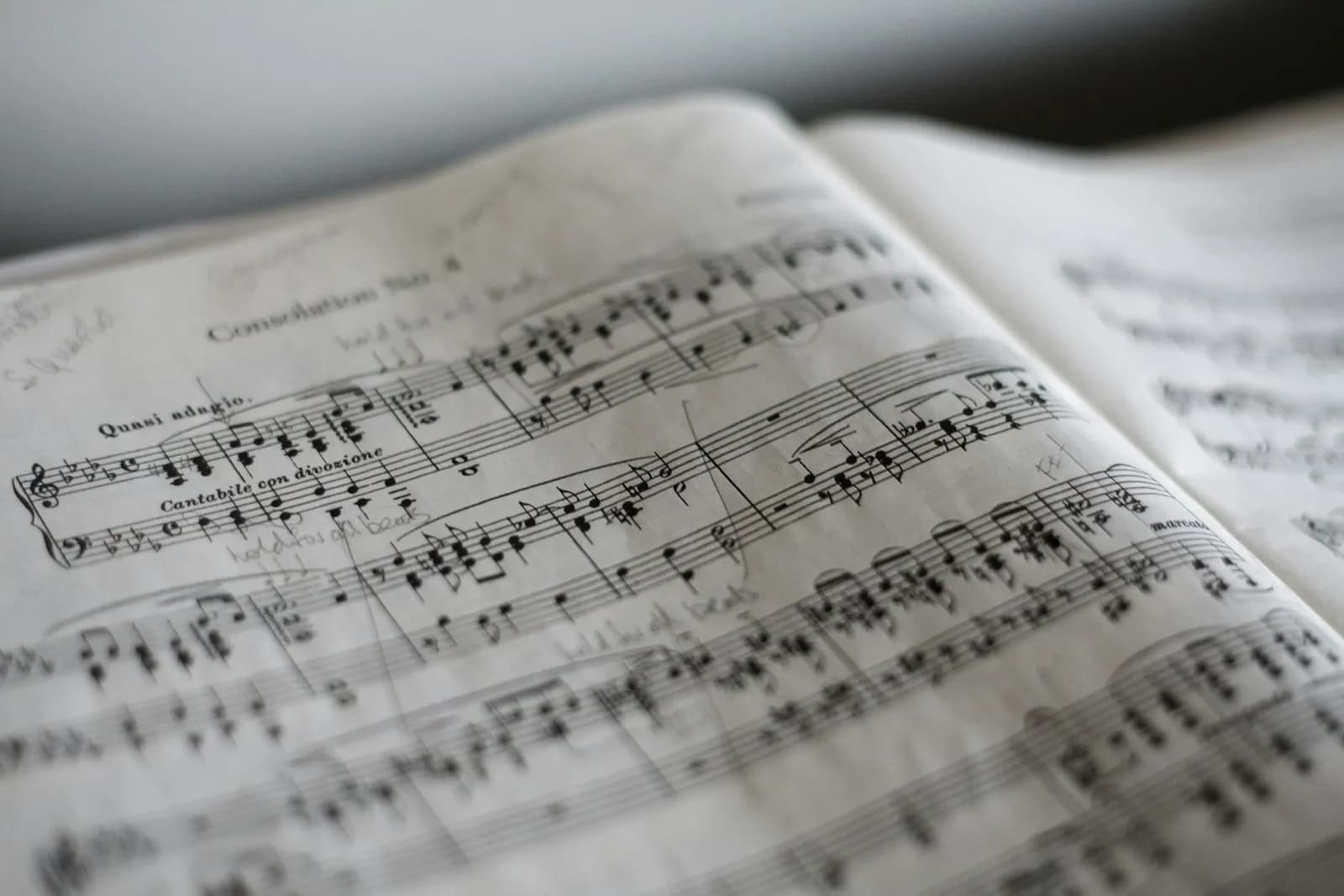
Syncopation places accents off the beat. Swing reshapes pairs of eighth notes into a triplet feel. Both turn straight time into something alive.
Listen to this lesson
Synthesized voice, not a studio recording
Ready to read aloud · 1/14
What you will learn
- What syncopation is and where it lives in a bar.
- How to feel and play a swing eighth note feel.
- Common syncopated rhythmic figures from funk and Latin.
- How to write rhythms that feel pushed or pulled.
The concept
A syncopation is any accent that falls where the listener expects silence: an off beat, a sixteenth, or a tie across a bar line. The brain expects strong beats on one and three in 4 4; a syncopation breaks that prediction and the music feels alive.
Swing is a specific kind of rhythmic deformation. A pair of straight eighth notes is replaced by a long short pair, mathematically close to two thirds plus one third of a beat. The triplet skeleton is what gives swing its lilt. Drop swing onto a metronome at 80 BPM and the metronome should sit on the down beat while your eighth notes lag and rush in a regular pattern.
On the guitar
Play a downstroke on beat one and an upstroke on the and of two. Add a downstroke on three and another upstroke on the and of four. That single bar already grooves.
Practice a one bar shuffle by counting one and a, two and a, then playing only on one and the a. That is the classic blues swing skeleton.
Exercises
- 01
Loop a metronome at 80 BPM and clap on the and of two and four for two minutes.
- 02
Play a single chord with a syncopated strumming pattern: down, miss, up, down up, miss, up.
- 03
Take a familiar straight eighth riff and play it with a swing feel. Compare them.
- 04
Write a four bar rhythm using only sixteenth notes, leaving deliberate gaps for syncopation.
Common mistakes
- Speeding up when you syncopate. The metronome stays in place; only your attacks shift.
- Treating swing as random looseness. It is a precise triplet ratio.
Listen, play, create
- Listen: Take Five by Dave Brubeck swings in 5 4 with a clear syncopated piano figure.
- Play: practice a sixteenth note funk strum with the pinky ghost notes felt but not heard.
- Create: rewrite a straight pop chorus as a swung version.
Use these tools
Further reading
Straight rhythm is a grid. Syncopation and swing are how you bend it. Both demand a steady internal pulse first.