
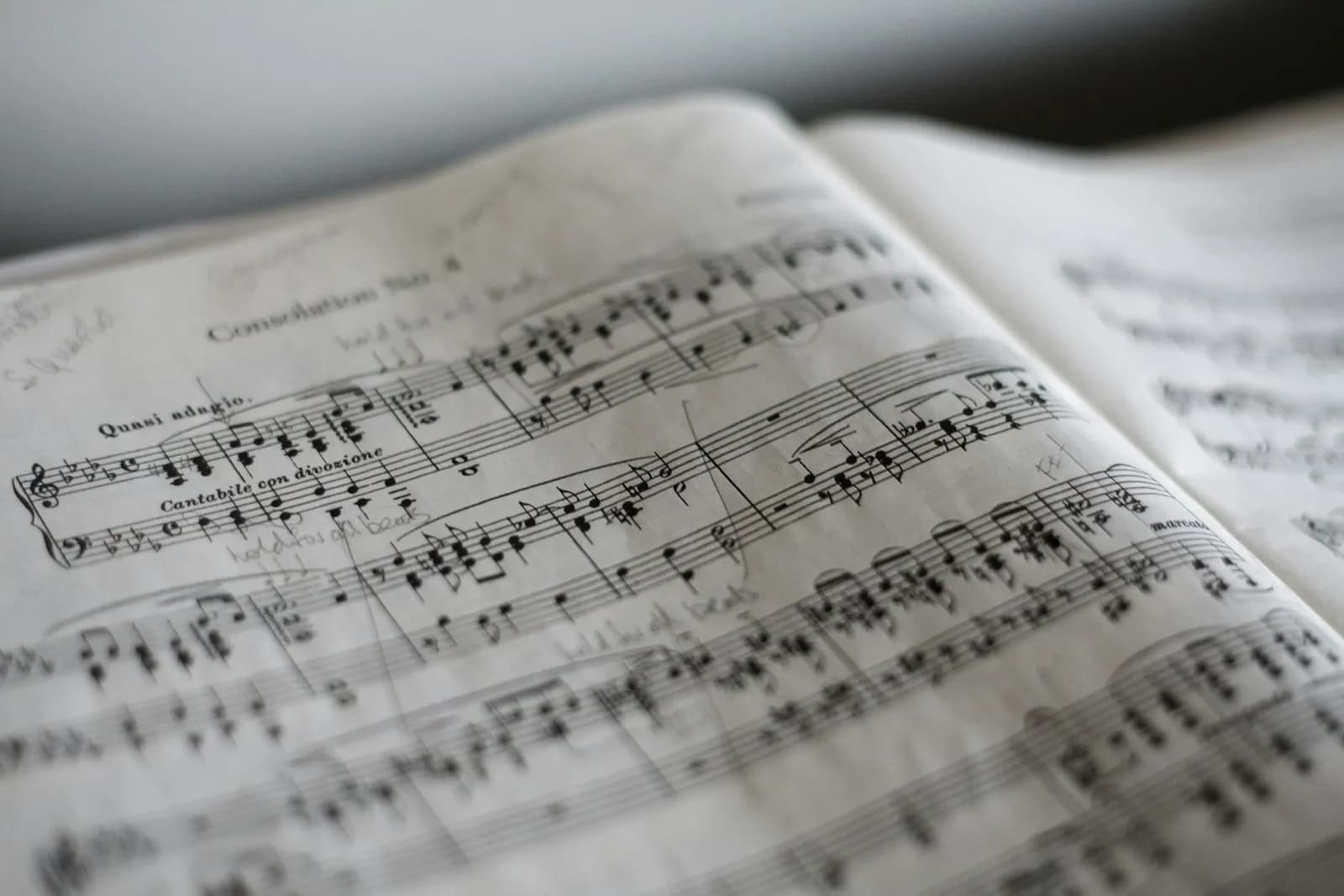
Major seventh, dominant seventh, minor seventh, half diminished, and diminished seventh, the five flavours that take you from folk into jazz.
Listen to this lesson
Synthesized voice, not a studio recording
Ready to read aloud · 1/17
What you will learn
- How to build each seventh chord by stacking thirds.
- Why the dominant seventh is the engine of tonal music.
- How seventh chords lead the ear from one chord to the next.
- Practical voicings for sixth-, fifth-, and fourth-string roots.
The concept
Add a fourth note a third above the triad and you get a seventh chord. The new note (the seventh) gives the chord a clear direction. Major seventh is dreamy. Dominant seventh feels restless and wants to resolve. Minor seventh is mellow and stable. Half diminished is fragile. Fully diminished is suspense personified.
On a single chord, the seventh is just a flavour. In a progression, it is fuel. A dominant seventh chord (V7) pulls toward the tonic so strongly because it contains a tritone, the most unresolved interval inside an octave, which resolves perfectly into the third and root of the I chord.
On the guitar
Play a G7 with G on the sixth string, B on the fifth, D on the fourth, F on the third. Then resolve it to C major. Notice how the F slides down to E and the B steps up to C. That is the tritone resolving.
Compare Cmaj7 (open C with B added on the second string fret zero) to C7 (open C with B flat on the third string fret three). Both share the C triad, but the seventh changes the whole mood.
Exercises
- 01
Build every seventh chord from a single root and play them in sequence to hear the colours change.
- 02
Find a V7 to I resolution in three different keys.
- 03
Play a ii7 V7 Imaj7 progression in C, G, and D.
- 04
Replace a triad in a song you know with the equivalent seventh chord and listen to the new mood.
Common mistakes
- Mixing major seventh with dominant seventh. Cmaj7 has B natural; C7 has B flat. The two sound nothing alike.
- Always voicing seventh chords with the root in the bass. Inversions and drop voicings often sound better.
Listen, play, create
- Listen: Autumn Leaves opens with a textbook ii V I in minor, full of seventh chord colour.
- Play: arpeggiate each seventh chord type up and down on the top four strings.
- Create: rewrite a folk progression replacing every chord with its seventh version.
Use these tools
Further reading
Seventh chords are where harmony stops being a frame and starts being a voice. Use them like adjectives, not decorations.